



[Hong Kong Commercial Daily] Hong Kong's first EV battery processing facility, operated by Chun Yang International (HK) Company Limited — a wholly owned subsidiary of Envision Greenwise Holdings Limited (1783) — was officially commissioned in June this year, opening a new chapter in Hong Kong's new energy circular economy and expected to reduce the city's carbon footprint by thousands of tonnes. Ms. Kwok Ho Yee, Chief Operating Officer of Envision Greenwise Group and Managing Director of Chun Yang International, expressed the Group's gratitude to the HONG KONG Government for granting it the final remaining site at EcoPark in Tuen Mun.
Construction of Hong Kong's first EV battery processing facility commenced in 2024. In the absence of comparable local experience, the project required only 24 months from ground-breaking to the issuance of its operating licence, entering full operation in June this year. Commenting on the expeditious and smooth delivery of the project, Ms. Kwok, who heads it, said in the interview: "Our company had accumulated substantial construction experience over the years. At the time of tendering, we had already prepared a comprehensive set of documentation that was, in effect, ready for building plan submission — in Hong Kong, building plan approval is the most demanding step in any construction project. In addition, we conducted thorough research and, at the tender stage, submitted concrete case references demonstrating how the project could be advanced and delivered more efficiently.”
An Intelligent Production Line Incorporating Patented German Technology
The Chief Executive, Mr. John Lee Ka-chiu, included the project in the 2025 Policy Address as one of the Government's policy objectives. Ms. Kwok noted that the Chief Executive's initiative had accelerated the project's completion, and that the Group had also secured funding approval under the New Industrialisation Funding Scheme. She emphasised, however, that land support remained the most critical enabler: "The successful tender for this EcoPark site was, in truth, the key to the development of this project.” She added that the standalone industrial site is located away from residential areas, and that the facility has been designed with a high-standard fire services system — resolving the safety concerns inherent in battery processing and affording conditions that conventional industrial buildings cannot offer.
On the principal challenge in delivering the power battery processing facility, Ms. Kwok said: "In my view, the greatest challenge is that no one in Hong Kong had previously processed ‘black mass’. Electric vehicle processing is an entirely new field, and finding the relevant certifications is relatively difficult.” The Group has introduced patented German technology to the facility and customised and upgraded it for the local market as an "Intelligent Battery Material Production Line”, capable of processing both lithium iron phosphate (LFP) and nickel-cobalt-manganese (NCM) lithium batteries, covering more than 90% of electric vehicle models in Hong Kong. The process further employs fully automated cleanroom production technology, generating virtually no odour and no pollution and maintaining a clean plant environment — dispelling public concerns about pollution from battery recycling.
She explained that whereas electric vehicles previously relied predominantly on NCM batteries, LFP batteries are now increasingly prevalent: "Hong Kong is a distinctive market — we have EVs from Europe, the Mainland, and elsewhere, covering a wide range of brands; batteries may be prismatic (square-pack), blade-type or cylindrical, and each contains a different chemical composition. Our production line is capable of processing all of them.” In addition, the production line has an annual capacity of 10,000 tonnes, equivalent to 20,000 to 30,000 sets of retired electric vehicle batteries — sufficient to meet Hong Kong's recycling demand for the coming years. According to the Environmental Protection Department, as at the end of July this year, Hong Kong had approximately 182,000 electric vehicles, accounting for around 19.7% of all vehicles. At present, 631 electric vehicle models from 21 economies have obtained type approval from the Transport Department, comprising 465 private car and motorcycle models and 166 public transport and commercial vehicle models.
Macao Lithium Battery Import Permit Granted
Chun Yang International was granted a Macao lithium battery import permit in June this year, formally establishing a circular channel between the two Special Administrative Regions of Macao and Hong Kong and setting a benchmark for Greater Bay Area cooperation. On the global positioning of the Group's battery processing business, Ms. Kwok noted that, leveraging more than 70 service points worldwide, the Group is actively developing localised processing solutions to build a closed-loop lithium battery supply chain.
In July this year, Envision Greenwise Group, together with China Resources Recycling International Development Co., Ltd. and Guangdong Brunp Recycling Technology Co., Ltd., a subsidiary of CATL (3750), jointly announced the establishment of Hong Kong Resources Recycling Int'l New Energy Limited. On the parties' future cooperation, Ms. Kwok said: "We will develop more in-depth cooperation agreements going forward, enabling Hong Kong to become a central processing hub where retired batteries can realise their value.”
FHKI's Jude Chow: Black Mass Recycling Is an Exemplary Demonstration of Hong Kong's New Quality Productive Forces
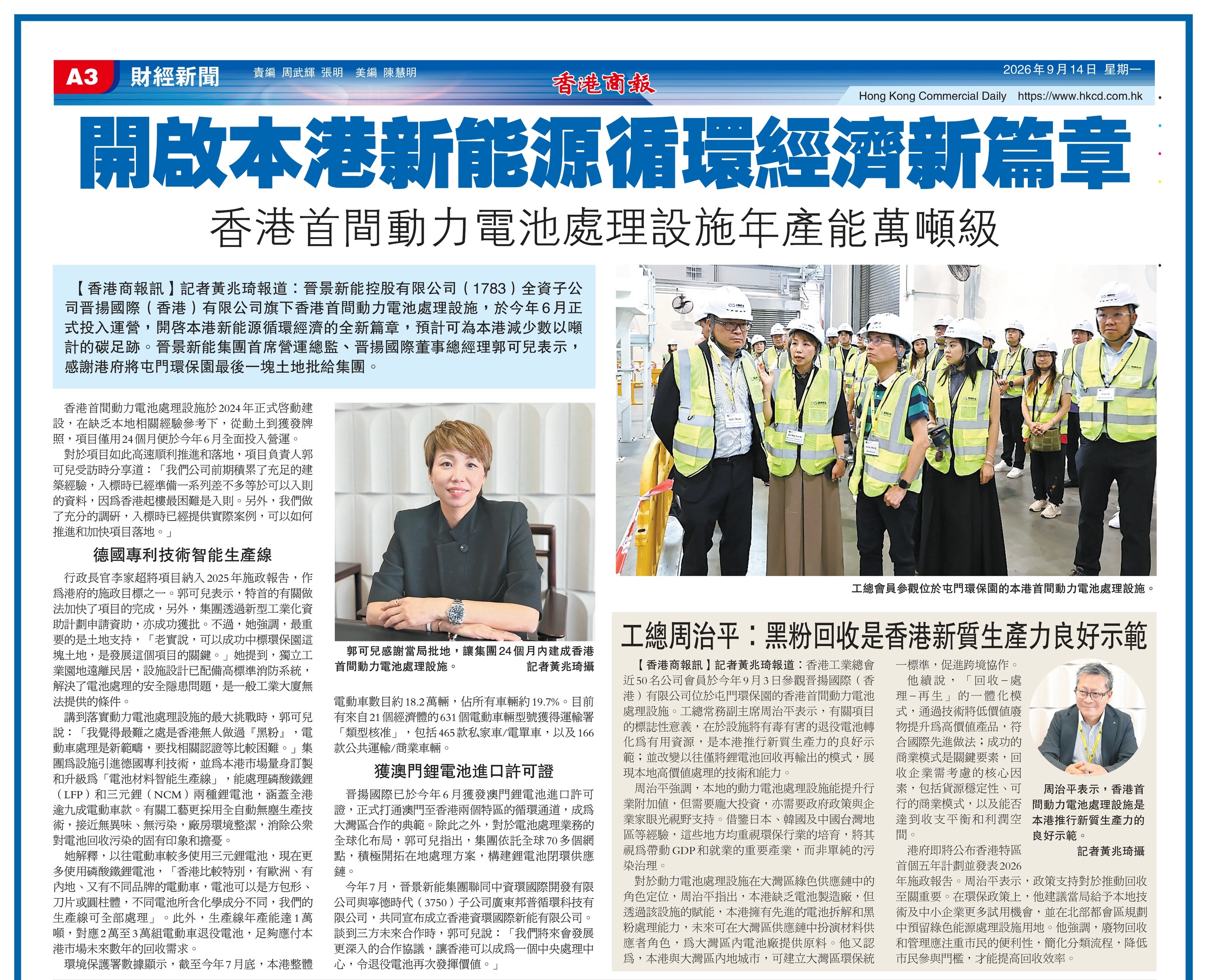
[Hong Kong Commercial Daily] On 3 September, approximately 50 corporate members of the Federation of Hong Kong Industries (FHKI) visited Hong Kong's first EV battery processing facility, operated by Chun Yang International (HK) Company Limited at EcoPark in Tuen Mun. Mr. Jude Chow, Executive Deputy Chairman of FHKI, noted that the project's landmark significance lies in the facility's conversion of toxic and hazardous retired batteries into useful resources — an exemplary demonstration of Hong Kong's advancement of new quality productive forces — and in its departure from the previous model of merely recycling lithium batteries for export, demonstrating the city's technological capability in high-value local processing.
Mr. Chow emphasised that local power battery recycling and processing facilities can increase industry added value, but they require massive investments, as well as support from government policies and the vision of entrepreneurs. Drawing on the experiences of Japan, South Korea, and Taiwan, these regions all attach great importance to cultivating the environmental industry, viewing it as a key sector for driving GDP and employment, rather than merely a pollution control measure.
As regards the facility's positioning within the Greater Bay Area's green supply chain, Mr. Chow pointed out that Hong Kong lacks battery manufacturing plants; yet, empowered by this facility, the city now possesses advanced battery dismantling and black mass processing capabilities, and will in future be able to assume the role of a materials supplier within the GBA supply chain, providing feedstock to battery plants in the region. He further considered that Hong Kong and mainland cities in the Greater Bay Area could establish unified GBA environmental standards to facilitate cross-boundary collaboration.
He continued that the integrated "recycle – process – regenerate” model, which employs technology to upgrade low-value waste into high-value products, is consistent with advanced international practice; a successful business model is the critical element, and the core considerations for recycling enterprises include the stability of feedstock supply, the viability of the business model, and the ability to achieve break-even and generate profit margins.
The HONG KONG Government is soon to publish the Hong Kong Special Administrative Region's first five-year plan and to deliver the 2026 Policy Address. Mr. Chow stated that policy support is of paramount importance in driving recycling. On environmental policy, he recommended that the authorities open up more pilot opportunities to local technologies and SMEs , and reserve land for green energy processing facilities in the Northern Metropolis planning. He stressed that waste recycling and management should prioritise public convenience, simplifying sorting procedures and lowering the threshold for public participation, so as to enhance recycling efficiency.


